NotesInsights7 mins read1,151 words
You Sent Another Resume Today. The Hiring Manager Probably Never Saw It.
Why the modern job search has quietly become a relationship problem, and what professionals can do about it
 Virre Team · July 7, 2026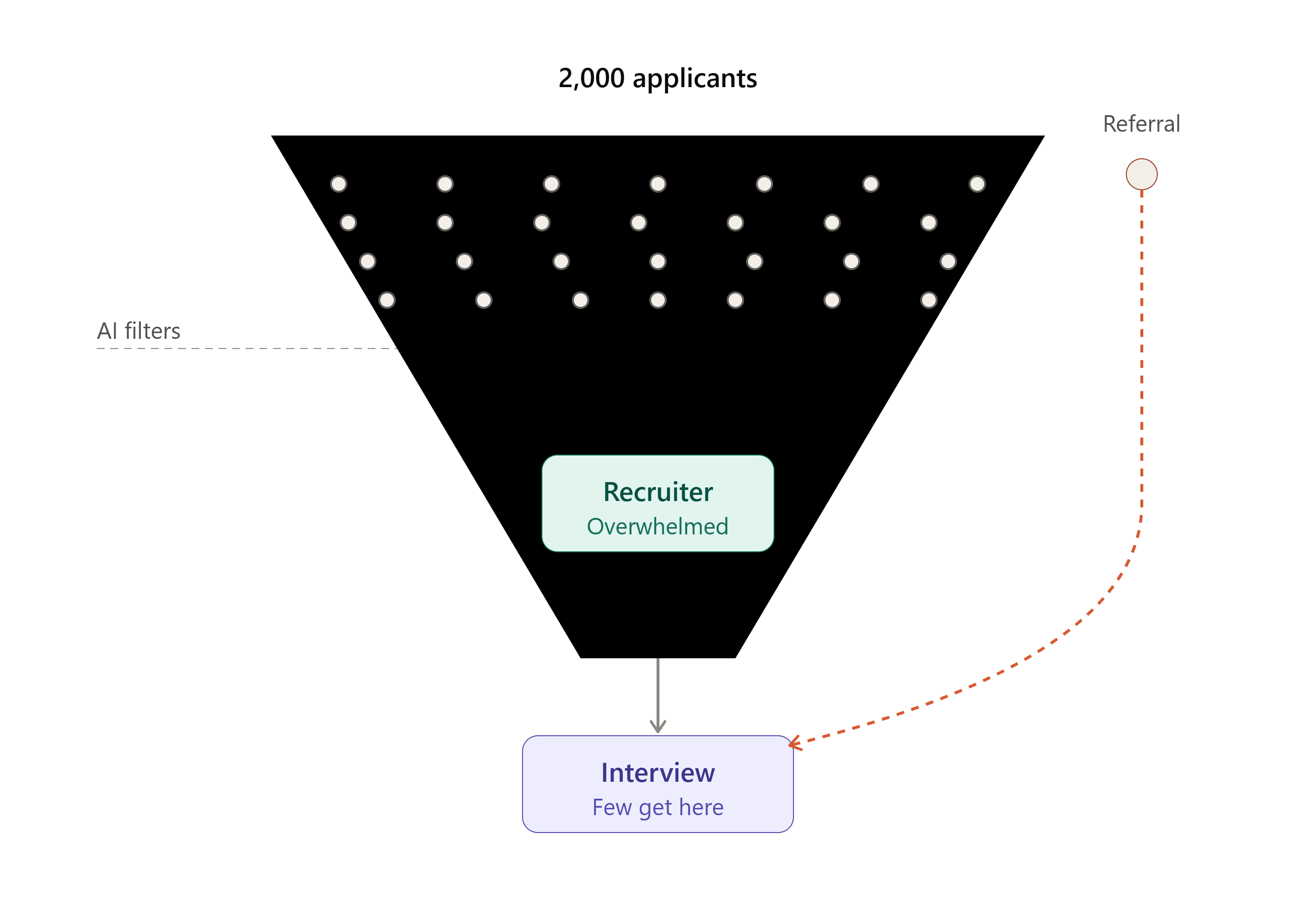
There is a moment that almost every job seeker reaches, although very few people admit it out loud because it feels strangely personal. It usually happens after several weeks of doing everything that career experts recommend. You have rewritten your résumé more times than you care to remember. You have optimized your LinkedIn profile, carefully matching keywords from job descriptions because someone told you that applicant tracking systems reward precision. You have asked friends to review your cover letter, completed another online certification because it seemed like the productive thing to do, and perhaps even used AI to polish every sentence before pressing the "Apply" button.
Then you wait.
A confirmation email arrives almost instantly, thanking you for your interest and assuring you that your application has been received. Days pass without another update. A week later another automated email appears, politely informing you that the company has decided to move forward with other candidates. There is no conversation, no feedback, and no indication that another human being ever read what you spent hours preparing.
The following morning you repeat the process because that is what everyone tells you successful job seekers should do. Apply to more positions. Customize every résumé. Stay positive. Trust the process.
After a while the process itself becomes exhausting. What began as optimism slowly turns into self-doubt. You stop questioning the market and begin questioning yourself. Am I missing a skill? Is my experience no longer relevant? Have I fallen behind everyone else?
For many professionals, especially those who have spent years building successful careers, this experience feels completely disconnected from the way hiring used to work. The rules appear to have changed almost overnight.
The uncomfortable reality is that they have.
01Why résumés alone are no longer enough#
Artificial intelligence is transforming work faster than organizations can rewrite job descriptions. Companies are restructuring entire departments while simultaneously investing in new technologies whose long-term impact even they cannot fully predict. Hiring managers are expected to identify people who will thrive in an environment that looks different every six months. Under those conditions, certainty becomes extraordinarily valuable.
This explains why the traditional job search has become increasingly frustrating. It is not because résumés have become unimportant. It is because résumés are no longer sufficient.
According to Microsoft's 2024 Work Trend Index, 66 percent of business leaders say they would not hire someone without AI skills, yet 71 percent also say they would rather hire a less experienced candidate who demonstrates AI aptitude than someone with more experience but lower adaptability. The message is surprisingly clear. Employers are no longer hiring only for what candidates know today. They are hiring for who they believe can grow tomorrow. (Source: Microsoft Work Trend Index 2024)
At almost the same time, LinkedIn reported that job applications on its platform have grown significantly year over year, making competition for every opening substantially more intense. Recruiters now face an overwhelming volume of qualified applicants, forcing them to make decisions under considerable uncertainty. (Source: LinkedIn Economic Graph and LinkedIn Talent Solutions)
When uncertainty increases, trust becomes more valuable.
02Why referrals still win#
That is why referrals continue to outperform cold applications. A trusted recommendation reduces risk. It tells a hiring manager that someone they already respect is willing to place their reputation behind another person. The recommendation does not eliminate the need for capability, but it often determines who receives the first conversation.
Unfortunately, this is exactly where many professionals struggle.
Most people have spent years building relationships with former colleagues, managers, professors, clients, recruiters, alumni, and mentors. Yet those relationships gradually become inactive, not because they lost value, but because life became busy. Months become years. Conversations fade. Reaching out begins to feel awkward precisely because too much time has passed.
Ironically, the people most capable of opening the next opportunity are often already sitting quietly inside your existing network.
The problem is that almost nobody has a practical system for maintaining those relationships.
LinkedIn helps us discover people. Email helps us communicate with them. Calendars remind us about meetings. None of those tools help us remember why someone mattered, what we last discussed, what goals they cared about, or whether this might be the right moment to reconnect.
Memory was never designed to manage hundreds of professional relationships across an entire career.
That realization became the foundation for Virre.
03How Virre helps#
Virre was not built to help professionals collect more connections. Most people already know more people than they actively remember. Instead, Virre helps professionals become intentional about the relationships they already have.
Using Virre's proprietary network classification framework, professionals can visualize the mentors, former managers, recruiters, alumni, founders, and industry peers who are most closely connected to a specific career objective. Instead of searching through thousands of contacts, they immediately see which relationships deserve attention.
Goal Mapping goes one step further by connecting those relationships to a concrete outcome. Whether the objective is finding a product management role, entering healthcare analytics, or transitioning into artificial intelligence, Virre highlights the people most likely to influence that journey.
Relationships, however, are built through consistency rather than visibility. That is why Relationship Timeline preserves the context surrounding every interaction. Meeting notes, introductions, career updates, and previous conversations remain attached to each relationship, making future conversations feel genuine instead of transactional.
Perhaps the most valuable capability is Next Best Actions. Rather than reminding professionals to contact everyone, Virre recommends the relationships that deserve attention now, based on goals, recent activity, and the natural rhythm of professional relationships. The result is not more networking. It is more thoughtful relationship building.
04What this means going forward#
The future of work will undoubtedly belong to people who continue learning new skills. That much is certain. Yet another truth is becoming equally important.
The professionals who thrive over the next decade will not necessarily be the ones who submit the greatest number of applications. They will be the ones who combine adaptability with trust, knowledge with relationships, and ambition with the discipline to invest in the people who shape careers over time.
Skills may help someone qualify for a role.
Relationships often determine whether the opportunity arrives in the first place.
05FAQs
Yes. Online applications remain an important part of any job search. However, referrals and trusted professional relationships consistently improve the likelihood of securing interviews because they reduce uncertainty for employers.
Both are essential. AI skills improve your ability to perform future work, while professional relationships increase your access to future opportunities.
LinkedIn helps professionals discover and connect with people. Virre helps them organize, nurture, and activate the relationships that matter most through features such as Network Map, Goal Mapping, Relationship Timeline, and Next Best Actions.
Professionals changing careers, job seekers, graduates entering the workforce, founders, executives, consultants, and anyone whose career depends on trusted professional relationships rather than cold outreach.