NotesComparisons10 mins read2,238 words
Virre vs Dex: Reminders Won't Close the Opportunity
Why follow-up reminders alone won't convert relationships into opportunities
 Virre Team · June 17, 2026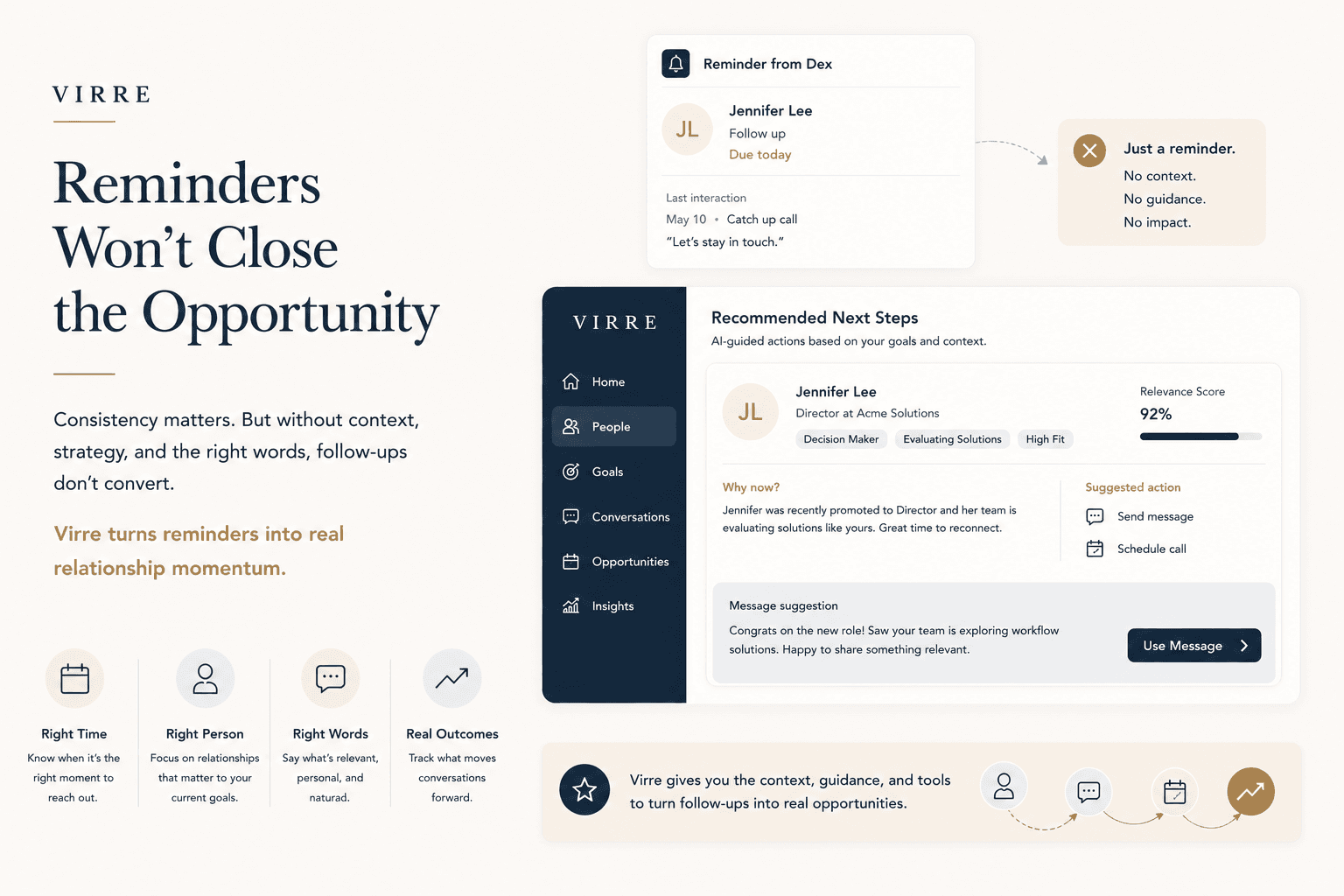
You set a reminder to follow up with Jennifer in two weeks. The alarm goes off. You open your contact list and see her name.
But you cannot remember what you talked about. You cannot remember why you should reach out to her now. And you definitely cannot remember what to say in the message that would make her actually want to talk.
That moment, where the reminder exists but the strategy does not, is exactly where Dex stops and Virre begins.
Dex solves one problem: it reminds you when to follow up. But reminders alone do not convert relationships into opportunities. What converts relationships into opportunities is knowing why you should reach out to this person right now, what makes them relevant to your goals, and what to say in a way that sounds genuine instead of automated.
It's worth naming the category question directly, since Dex and Virre are usually grouped together as "personal CRM" tools. Neither one manages a sales pipeline, which is what a CRM actually does. What's really being compared here is two different theories of follow-up: consistency versus strategy.
This article breaks down what Dex does well, where it falls short, and how Virre approaches follow-up as a complete system instead of just a reminder engine.
01What Dex Gets Right About Relationship Consistency#
Dex is built around a clear insight: most professionals lose relationships not because they lack information but because they forget to follow up.
That insight is correct. Consistency matters. The professionals with the strongest networks are rarely the smartest people in the room. They are the people who stay in touch.
Dex solves that problem. You set a reminder frequency for each contact: follow up every two weeks, monthly, quarterly. When the time comes, Dex surfaces the contact and shows your last interaction: previous messages, notes, meeting history.
For people who struggle with follow-up discipline, this is genuinely useful. The reminder becomes a forcing function. You have to do something.
The interaction timeline is also helpful. Before messaging someone, you can quickly scan what you talked about last time. That prevents you from asking about a project they already finished or repeating a story you already told.
Dex has solved a real problem: forcing consistency in follow-up and preventing cold memory.
02Where Reminders Alone Fall Short#
The gap between being reminded to follow up and actually knowing what to say is enormous.
A reminder tells you it has been two weeks. It does not tell you whether this is actually the right moment to reach out. It does not tell you whether this person is relevant to what you are working on right now. And it definitely does not help you craft a message that sounds like a genuine connection instead of an obligation.
Consider a founder managing relationships with 50 potential investors. Dex reminds her to check in with each one every two weeks. So she sends 50 messages. But here is what those messages look like without strategy: "Hey, how have you been?" or "Just checking in."
Those messages do not convert to meetings. They convert to short responses that go nowhere.
What should actually happen: she should identify which 12 of those 50 investors are relevant to her Series A goal right now. She should reach out to each one only when there is a real reason: a product update, a market shift, a personal milestone that matters to them. And she should say something that proves she was actually paying attention: "I saw your piece on AI safety regulations. We are building exactly this. Would love to get your thoughts."
Dex cannot do any of that work.
The same limitation shows up everywhere. A sales professional gets reminded to check in with a prospect, but the reminder does not tell her this is the right moment because the prospect just moved into a decision-making role. A job seeker gets reminded to stay in touch with contacts but has no idea which 10 of 50 relationships are actually relevant to the roles she is pursuing. A career transitioning professional gets reminded to follow up but does not know whether this relationship is warming properly toward a future transition.
Reminders create activity. They do not create strategy.
03How Virre Approaches Follow-Up Differently#
Virre starts with a different question: What is the right move right now, and what does it look like?
Know What to Reach Out About
Instead of reminding you to follow up with everyone on a fixed schedule, Virre helps you understand who actually deserves your attention right now.
The founder gets a list of investors to reach out to this week, ranked by relevance to her Series A goal. The sales professional sees which accounts need attention based on deal stage, not calendar time. The job seeker sees which relationships in her network just moved to relevant roles or companies.
Virre uses AI to match contacts to your current goals, so you are not following up for the sake of following up. You are following up because there is a real reason.
For the mid-level professional pursuing senior leadership, Virre identifies executives who made similar moves, people who are positioned to refer him, and recruiters who focus on senior roles. Then it surfaces the right moment: "This recruiter just worked a similar search. This person just got promoted and can advise you."
That is not just a reminder. That is a strategy.
Understand Why They Matter Right Now
Once Virre identifies who to reach out to, it explains why.
Virre's AI transparency shows: "Jennifer moved into Director role. From your closed-loop context, her team mentioned evaluating solutions. This is relevant to your pipeline goal."
That explanation serves two purposes. It gives you confidence that reaching out is natural. It also makes the message easy to write. You now know why you are reaching out and what to reference.
For the undergrad who met 50 people during an internship and wants to convert that into a full-time offer, Virre identifies the people who are actually decision-makers or influencers. It shows: "Sarah is on the hiring committee. You met her during onboarding and worked together on the project she mentioned wanting help on."
That context is not a reminder. It is a strategy.
Know What to Say (The Part Dex Cannot Solve)
This is where the real gap appears.
Dex shows you your last interaction. Virre shows you your last interaction AND helps you craft a message that actually lands.
Virre Chat is an AI assistant designed to help you avoid the mistakes that kill networking: being too salesy, too generic, too transparent about your needs.
With Dex alone, you open the reminder and write: "Hey, how have you been? Would love to catch up." Jennifer ignores it. She gets that message from 20 people a week.
With Virre Chat, you get guidance: "You have not talked to Jennifer in two months. You know she mentioned wanting to evaluate solutions. You also know her team is in Q2 planning. What would make sense to say?"
Virre helps you write: "I remember you mentioned the team wanted to evaluate solutions this quarter. Saw some changes in your department. Would love to grab 20 mins to catch up on what is on your plate."
That message is specific, grounded in something real, and gives Jennifer a reason to respond. That is the difference between a reminder and a conversation.
Track Whether It Works
Dex records when you last touched a contact. Virre tracks whether that touch is actually moving toward an outcome.
When the founder reaches out to an investor, Virre tracks that conversation as a warm path to funding. It marks whether a meeting happens, what comes next, and eventually whether it converts.
For the sales professional, Virre tracks whether that conversation moves a deal forward or just sits dormant.
For the job seeker, Virre tracks which relationships are actually leading to interview opportunities and which ones are just polite responses.
That outcome tracking is what transforms follow-up from activity into strategy.
04How They Compare: Feature by Feature#
| Feature | Dex | Virre |
|---|---|---|
| Set follow-up reminders | Yes | Yes, but strategic |
| See last interaction | Yes | Yes, plus closed-loop context |
| Interaction timeline | Yes, clear view | Yes, plus deep intelligence |
| Know if it is the RIGHT time | No | Yes, matches to your goals |
| Understand why to reach out | No | Yes, AI transparency |
| Get help writing the message | No | Yes, Virre Chat |
| Avoid salesy language | No | Yes, specifically designed for this |
| Search within network | Basic search | AI-powered search with recommendations |
| Expand network beyond existing | No | Yes, search for adjacent people |
| Track if it converts | No | Yes, outcome tracking |
| Auto-organize contacts | No | Yes, AI tags plus custom tags |
| Understand closed-loop context | No | Yes, from emails, calls, notes |
05Who Each Tool Is Best For#
Dex works best for: People who struggle with basic follow-up discipline. Professionals managing small, stable networks where reminders alone create accountability. Job seekers or operators who need simple timeline management and nothing more. People who do not mind sending generic follow-up messages and accept low response rates.
Virre works best for: Founders managing warm investor networks. Sales professionals with complex, multi-threaded deals. Job seekers trying to convert networks strategically. Career transitioners maintaining relationships over months or years. Undergrads and grads nurturing internship relationships. Senior professionals building board networks. Mid-level professionals pursuing executive roles.
06Real Use Cases: How They Differ in Practice#
Founder Fundraising
Dex: Reminds you to stay in touch with investors. You send "How have you been?" messages to 50 people.
Virre: Identifies 12 investors relevant to your Series A goal. Shows why each matters. Helps you message each one with something real: "I saw your investment in similar space. Want to grab coffee to talk about AI safety approaches?"
Sales Professional
Dex: Reminds you to follow up with prospects. You call and ask "Where are we on this?"
Virre: Identifies which relationships are actually moving toward deals. Shows that Jennifer just moved to a decision-making role. Understands her team mentioned timeline for evaluation. Helps you say: "Saw the timeline for your evaluation. Want to make sure our solution fits what you need."
Job Seeker
Dex: Reminds you to stay in touch with contacts. You message everyone: "Let me know if you hear about opportunities."
Virre: Identifies 15 people at target companies who matter for YOUR job search. Shows which ones are in hiring teams. Helps you reach out meaningfully: "Saw your post about the new team. I am interested in the role. Would love to talk about how my background fits."
Career Transition
Dex: Reminds you to check in with peers and seniors every month.
Virre: Identifies which peers made similar moves. Shows when someone moves to a relevant role. Helps you reach out naturally: "Heard you moved to Director. We talked about this path a year ago. How has the transition been? I'm thinking about the next move."
Undergrad Converting Internship
Dex: Reminds you to stay in touch with people you met. You message: "Great to meet you."
Virre: Identifies 12 people who are decision-makers or influencers. Shows closed-loop context: you worked with Sarah on a project. Helps you message: "Working on the deployment issue we discussed. Would love your input on scaling approach."
Senior Woman Building Board Network
Dex: Reminds you to check in monthly with contacts.
Virre: Identifies women who became board members. Identifies recruiters who focus on board placements. Shows when someone moves to relevant role. Helps you reach out: "Saw your board role at XYZ. Would love to understand your journey. I'm thinking about board opportunities in 3 years."
Mid-Level Professional Pursuing Senior Role
Dex: Reminds you to stay in touch with recruiters and senior leaders.
Virre: Identifies which recruiters work on senior roles in your field. Identifies peers who moved to director/VP. Shows when a recruiter works a relevant search. Helps you reach out: "Working a search in our space. Would love to understand if I am in your target profile and what I should be working on."
07The Difference: Activity vs. Strategy#
Dex creates a system where you follow up consistently.
Virre creates a system where you follow up strategically.
Consistency matters. But strategy matters more.
The strongest professional networks do not come from following everyone up on a fixed schedule. They come from reaching out to the right people at the right moments with genuine reasons that matter to them.
Dex gets you to send the message. Virre helps you know which message to send and makes sure it actually lands.
08Start Strategic Follow-Up Instead of Just Consistent Follow-Up#
The strongest relationships come from being in touch at the right moments with genuine reasons to connect.
Virre helps you identify those moments automatically and gives you the confidence and language to actually reach out in ways that feel human instead of like a reminder alarm. That's a strategy problem, not a reminders problem — which is why Virre is relationship intelligence rather than a CRM with notifications.
Start a free trial at virre.ai and stop sending generic follow-ups that go nowhere.
09FAQs
Dex is a relationship management tool that reminds you when to follow up with contacts based on a frequency you set. It shows your last interaction and helps you remember what you talked about so you do not repeat yourself.
Both tools support consistency. The difference is that Virre tells you not just when to follow up but why this is the right moment to follow up and what makes the person relevant to your goals. Virre also helps you craft messages that actually land instead of generic follow-ups.
For job searching, Virre is significantly better. Dex reminds you to stay in touch with your network. Virre identifies which people in your network are actually relevant to the jobs you are pursuing, understands what roles they influence, and helps you reach out in a way that feels natural.
You could, but most people find that Virre's built-in reminders (strategic rather than calendar-based) and closed-loop context remove the need for Dex. Virre's reminders are smarter because they are based on relevance and goals, not just time elapsed.
Dex can remind you to stay in touch with investors. It does not tell you which investors matter most, when the right moment to reach out is, or what to say that will actually move toward a funding conversation. For fundraising, Virre is significantly more powerful.
Both remind you to follow up. The difference is why and what. A calendar reminds you it has been two weeks. Virre tells you whether this person is relevant to your goal right now, why reaching out matters, and what to say to make it land.