NotesComparisons10 mins read1,860 words
Virre vs Notion: A Database Is Not a Relationship System
Why organizing contact information is not the same as converting relationships
 Virre Team · May 25, 2026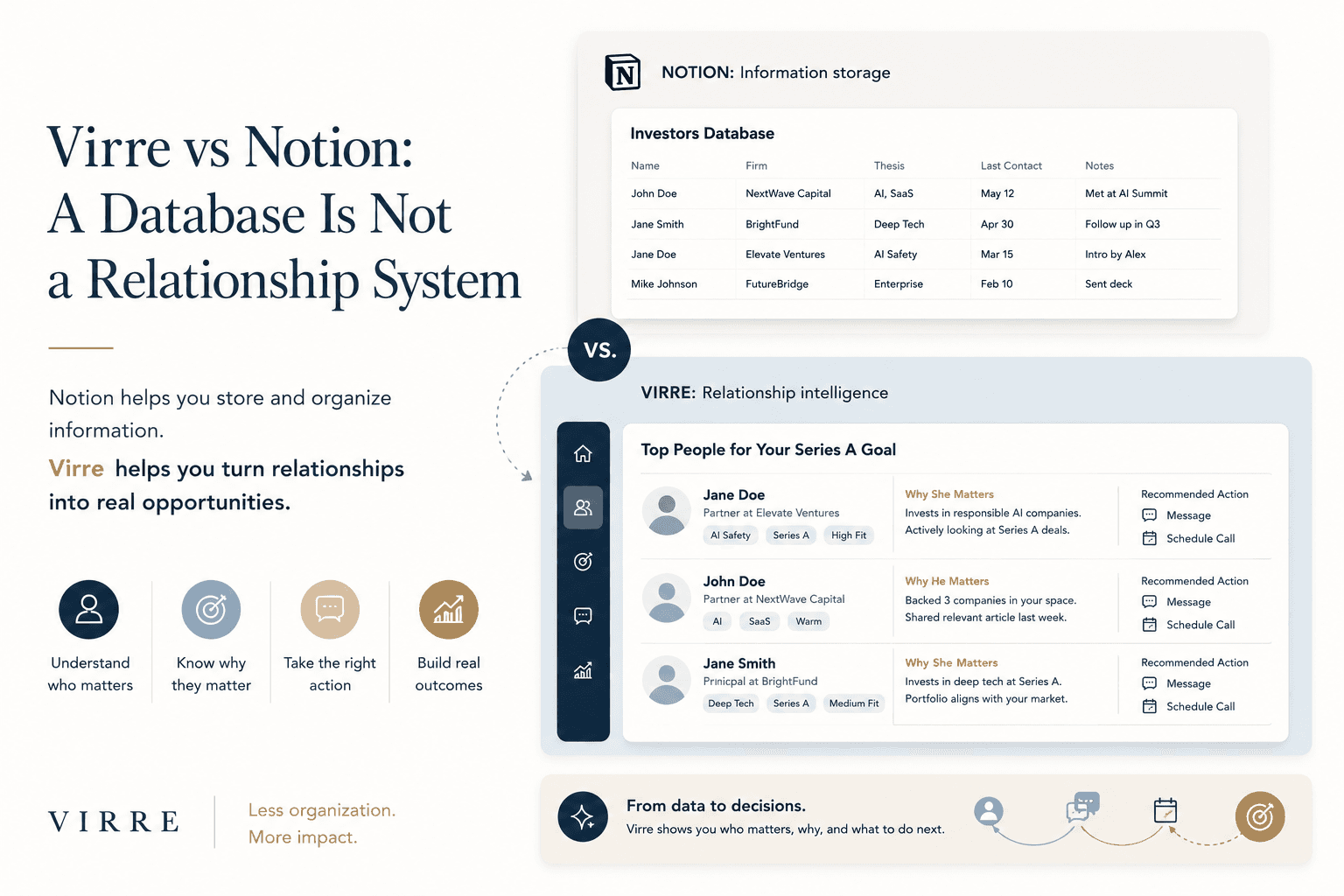
You set up a Notion database to track your network. You create fields for: contact name, company, role, last interaction, notes, follow-up date.
Now you have organized information. You can see everything in one place. You can filter and search your contacts.
But you still do not know which people matter for your current goals. You still do not know what to say when you reach out. You still do not know whether your follow-ups are actually moving toward outcomes.
That gap, between organizing information and converting relationships, is exactly where Notion stops and Virre begins.
Notion is a database tool. It excels at storing, organizing, and displaying information in flexible ways. Virre is a relationship conversion system. It helps you turn your network into real opportunities.
It's worth naming the category question directly, since Notion often gets grouped with "personal CRM" tools in comparisons like this one. Notion isn't a CRM, and neither is Virre. A CRM manages a sales team's accounts and deal stages. What's actually being compared here is two different approaches to a personal relationship problem: a flexible database you build yourself, versus a system built to reason about which relationships matter and when.
This article explores what Notion does well, where it falls short, and how Virre approaches relationship management as intelligence, not just organization.
01What Notion Gets Right About Contact Organization#
Notion solves a real problem: most professionals have contact information scattered everywhere.
Notion lets you create a single database for your network. You can add custom fields, relationships between contacts, timelines, and notes. You can filter by company, role, or any other criteria you define.
The flexibility is genuinely impressive. You can build exactly the structure you need for how you work.
For people who enjoy organizing information and building systems, Notion is powerful. You can create something that feels custom and tailored to your specific needs.
But organization is not the same as intelligence.
02Where a Database Approach Falls Short#
Notion answers one question: "How do I organize and store contact information?"
It does not answer the questions that actually matter: "Which contacts matter for my goals?" "Why should I reach out now?" "What should I say?" "Is this working?"
Consider a founder using Notion to track investors. She creates a database with fields: investor name, fund, investment thesis, portfolio companies, last contact date, notes.
She spends hours organizing information about 50 investors. She has everything documented beautifully.
But she still does not know which 12 are actually relevant to her Series A goal in AI safety. She still does not know whether Sarah's fund is even interested in her space. She still does not know what to say in a message that would make Sarah excited to talk.
So she ends up manually going through her database, figuring out who to reach out to, and guessing at what to say. That is not leverage. That is busywork disguised as system-building.
The same limitation appears everywhere. A sales professional builds a Notion database of 50 prospects but still has to manually figure out which 8 are hot for current deals. A job seeker builds a Notion database of 300 contacts but still has to manually identify which ones work at target companies.
Notion optimizes for organization. It does not optimize for outcome.
03How Virre Approaches Relationships Differently#
Virre starts with a different assumption: a relationship system should help you move something forward, not just remember what you have.
AI Does the Organization for You
Instead of you building a database and manually organizing contacts, Virre automatically consolidates and organizes.
Virre pulls conversations from emails, calls, notes, and messaging. It auto-generates tags based on what it learns about each person. You do not have to manually create fields and fill them in.
The founder does not spend hours setting up a Notion database. Virre automatically consolidates investor information and auto-tags by investment thesis, geography, stage focus.
For the job seeker, Virre automatically identifies contacts at target companies and tags them by role, hiring stage, and relationship strength.
That frees you from the busywork so you can focus on the actual strategy.
Intelligence Replaces Information
Notion shows you information: job title, company, last contact date.
Virre shows you intelligence: why this person matters for your goal right now, what they care about, what you should say.
The founder's Notion database shows: "Sarah is a fintech investor. Last contact: 6 months ago."
Virre shows: "Sarah invested in AI safety companies. You both care about responsible AI regulation. She is actively looking at Series A opportunities. This is the right moment to reach out. Here is what to say."
That is not just information. That is strategic intelligence.
Strategic Recommendations Replace Manual Filtering
Notion requires you to manually query your database. You search "investors in AI" and get back results. You have to read each one and figure out who matters.
Virre proactively recommends. It shows you: "These 12 investors are relevant to your Series A goal. These 5 are adjacent. These 33 are nice to know but not critical right now."
You do not have to build the query. You do not have to manually filter. Virre does it automatically based on your goals.
For the sales professional, Virre does not require her to search her Notion database for "hot deals." Virre tells her which prospects are moving toward close and which need attention right now.
Chat Assistance Replaces Blank Messages
Notion is a database. It cannot help you write messages.
Virre Chat helps you craft outreach that actually lands.
The founder using Notion has to figure out what to say to Sarah. She probably writes something generic: "Would love to catch up."
Virre Chat helps her write something genuine: "Saw your investment in responsible AI. We are building solutions for that space in Series A. Want to grab coffee to discuss your regulatory outlook?"
That message converts because it is specific and shows you were listening.
Outcome Tracking Replaces Static Records
Notion lets you record when you contacted someone. Virre tracks whether that contact is moving toward an outcome.
In Notion, you update a field: "Last contact: today." That is documentation, not intelligence.
In Virre, you reach out to an investor. Virre tracks: "Warm path to Series A funding opened. Awaiting response." Then: "Meeting scheduled." Then: "Investment conversation advancing."
That is outcome tracking. You can see which relationships are moving forward and which are stalled.
04How They Compare: Feature by Feature#
| Feature | Notion | Virre |
|---|---|---|
| Organize contacts | Yes | Yes, auto-organized |
| Store contact information | Yes | Yes, auto-enriched |
| Custom fields | Yes | Limited, purpose-driven |
| Search/filter | Yes, manual | Yes, AI-powered |
| Consolidate conversations | Manual entry | Yes, automatic |
| Understand what people care about | No | Yes, closed-loop intelligence |
| Match to your goals | No | Yes, automatic |
| Recommend who to reach out to | No | Yes, proactive |
| Get help knowing what to say | No | Yes, Virre Chat |
| Track outcomes | Manual | Yes, automatic |
| Deep intelligence | No | Yes, contextual signals |
| AI transparency | No | Yes, explains connections |
| Follow-up reminders | Optional field | Yes, strategic timing |
| Auto-tag contacts | No | Yes, AI-generated |
05Who Each Tool Is Best For#
Notion works best for: People who love building systems and organizing information. Professionals with small networks where manual organization is feasible. People who want complete control over how data is structured. Teams who want a shared contact database. Organizations that need custom CRM without paying for Salesforce.
Virre works best for: Founders managing warm investor networks. Sales professionals with complex deals. Job seekers trying to convert networks. Career transitioners building long-term relationships. Undergrads and grads nurturing internship relationships. Senior professionals building board networks. Mid-level professionals pursuing executive roles.
Founder Fundraising
Notion: You build a database of 50 investors with fields for fund size, thesis, portfolio companies, last contact. You manually track who to reach out to.
Virre: Virre identifies 12 investors relevant to your Series A goal. Shows why each matters. Helps you reach out naturally. Tracks which conversations become meetings.
Sales Professional
Notion: You create a Notion database of 50 prospects with deal stage, contact history, notes. You manually update which ones are hot.
Virre: Virre identifies which prospects are moving toward close. Shows what they mentioned that matters. Recommends when to reach out. Tracks deal progression automatically.
Job Seeker
Notion: You build a database of 300 contacts with company, role, last interaction. You manually search for people at target companies.
Virre: Virre identifies 15 contacts at target companies and 30 connected to hiring. Shows which ones are in relevant roles. Helps you reach out naturally. Tracks conversion to interviews.
Career Transition
Notion: You track peers and mentors in a database. You manually manage when to reach out.
Virre: Virre identifies which peers made similar moves. Shows when someone moves to relevant role. Helps you reach out naturally. Tracks warming toward future transition.
Undergrad Converting Internship
Notion: You create a database of 50 internship contacts with notes about each one. You manually decide who to prioritize.
Virre: Virre identifies 12 decision-makers and influencers. Shows which ones you worked with on projects. Helps you message about shared work. Tracks conversion to offers.
Senior Woman Building Board Network
Notion: You track board-connected contacts in a database. You manually manage relationship building.
Virre: Virre identifies women who became board members. Shows recruiters focused on board placements. Helps you understand their journeys. Tracks warming toward board goal.
Mid-Level Professional Pursuing Senior Role
Notion: You build a database of executives and recruiters. You manually manage outreach cadence.
Virre: Virre identifies executives who made similar moves. Shows recruiters working senior roles in your field. Helps you reach out about their paths. Tracks which conversations warm toward opportunity.
06The Real Question: Store or Convert?#
Notion answers: "How do I organize and store contact information?"
Virre answers: "How do I turn my network into the outcomes I need?"
Both are legitimate questions. But they serve completely different purposes.
If you want to build a custom organization system and enjoy the process, Notion is good. You can create something that feels like yours.
If you are trying to move something forward and need intelligence on top of organization, Notion creates friction. You build a beautiful database but still have to do all the strategic work manually.
That is when Virre becomes essential. It handles organization automatically so you can focus on strategy and conversion.
07Stop Building Databases and Start Converting Relationships#
The strongest networkers do not spend their time organizing contact information. They spend their time turning relationships into outcomes.
Virre handles the organization so you can focus on conversion. That focus is what makes it relationship intelligence rather than a database or a CRM — a different category, built around a different question.
Start a free trial at virre.ai and stop building Notion databases that look good but do not move anything forward.
08FAQs
Notion is a flexible database and note-taking tool that lets you organize information any way you want. You can create custom contact databases, track interactions, and store notes about relationships. It is powerful for organizing but does not provide strategic intelligence.
Notion lets you organize and store contact information. Virre organizes contacts automatically and adds strategic intelligence on top: understanding who matters for your goals, when to reach out, what to say, and whether it is moving toward outcomes.
You could, but most people find Virre's automatic organization removes the need to manually build a Notion database. Virre handles the data layer and adds the intelligence layer on top.
Notion can help you organize investor information. It does not tell you which investors are relevant to your specific fundraising goal or how to pitch them effectively. For fundraising, Virre is significantly more powerful.
For job searching, Virre is better. Notion can help you organize contacts at target companies. Virre identifies which ones are in hiring for your target roles and helps you reach out in ways that lead to interviews.
Building a Notion database is worth the effort if you enjoy organizing information and want a custom system. It is not worth the effort if you want to move something forward quickly. Virre does the organization automatically.
Virre is not a database that you organize. It is an intelligence system that automatically organizes your data and tells you what to do with it. That is a fundamentally different approach.