NotesComparisons10 mins read2,069 words
Virre vs Clay: Data Alone Won't Get You the Opportunity
Why contact enrichment is not the same as relationship conversion
 Virre Team · June 4, 2026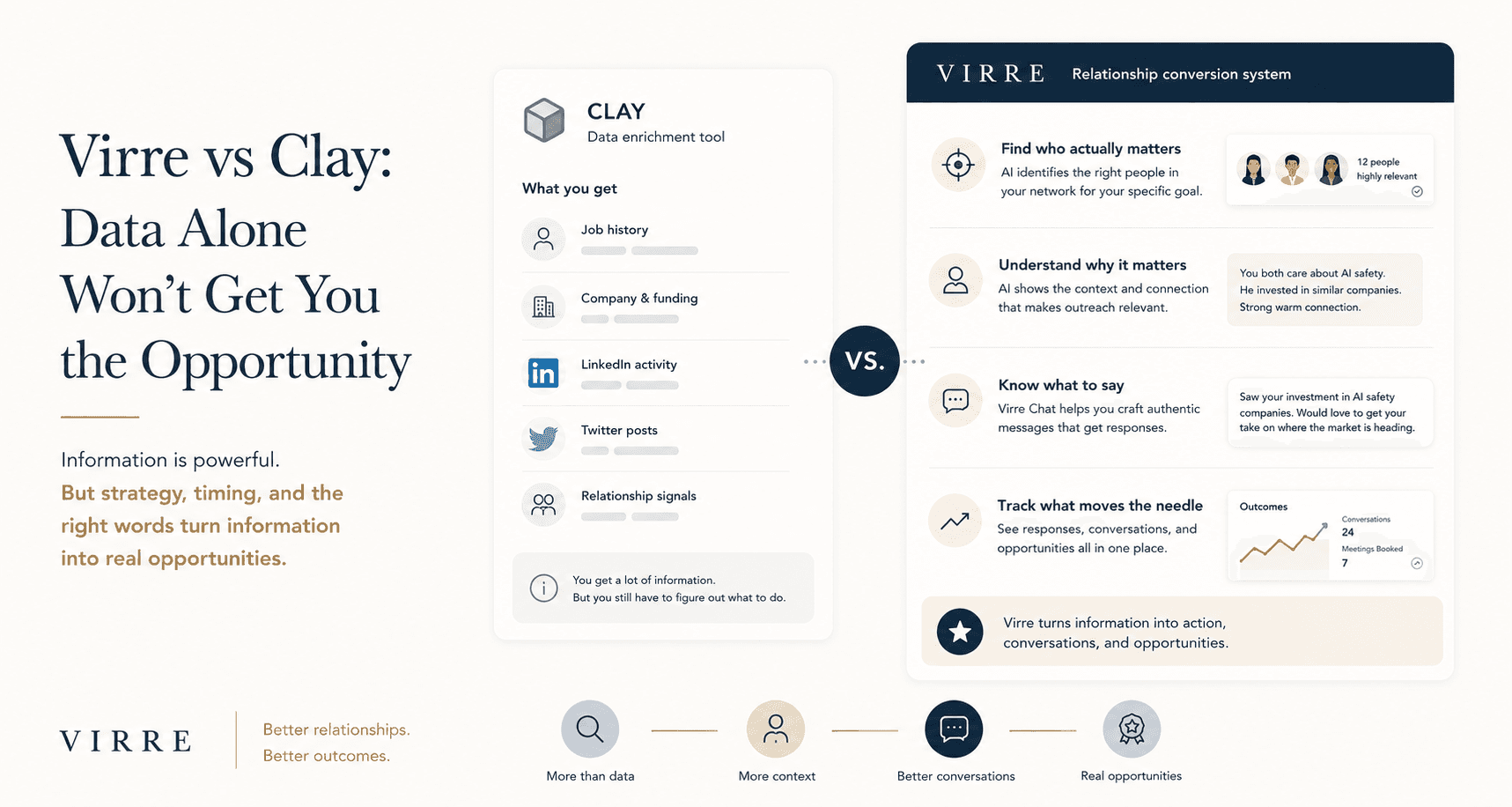
You spent two hours researching a prospect on Clay. You found her job history, her company funding, her LinkedIn activity, her Twitter posts. You know everything about her.
Then you hit send on a message and get no response.
The problem is not the data. You had all of it. The problem is you didn't know what to say, when to say it, or why she should care that you reached out. Rich information about someone is not the same as knowing how to turn that information into a conversation.
That gap sits at the center of why founders, sales leaders, and ambitious professionals are moving away from research-first tools like Clay and toward platforms like Virre that combine data with strategic guidance, conversation support, and outcome tracking.
It's worth naming the category question directly, since Clay and Virre both show up in "personal CRM" roundups. A CRM manages deal pipelines for a sales org, and neither tool does that. What's actually being compared is two different answers to enrichment: depth of data versus depth of strategy.
This article explores what Clay does well, where it falls short, and how Virre takes a fundamentally different approach to turning professional relationships into real opportunities.
01What Clay Gets Right About Contact Intelligence#
Clay is built around one clear premise: your network is more valuable when you understand it deeply. The platform pulls together professional background data, company information, funding history, social activity, and relationship signals into enriched contact profiles.
That premise is correct. Context matters. Walking into a conversation prepared is better than walking in cold.
Clay does this well. You connect your contacts, and Clay immediately layers on professional history, company details, recent activity, and relationship mapping. The data is legitimate and useful.
For professionals whose work involves heavy research before outreach, Clay creates efficiency. Instead of manually hunting through five different sources for someone's background, Clay assembles it in one place.
The problem is what happens next.
02Where Data Enrichment Stops#
Here's what Clay cannot do: it cannot tell you why reaching out to this person matters for your specific goal right now.
Clay shows you that Sarah is a fintech investor. But if you are a founder raising Series A in healthcare, that information alone is not useful. You need to know: Is Sarah relevant to YOUR fundraising? Should you prioritize her or someone else? What's the most natural thing to say to her given your relationship history?
These are not data questions. These are strategic questions.
Consider a sales professional managing dozens of accounts. Clay can tell you everything about Jennifer: her new title, her company, her job history. But Clay cannot tell you this is the right moment to reach out because she just moved into a decision-making role and your product solves a problem her department just inherited. That requires understanding her goal, your product, and the timing of her career move. Data enrichment alone cannot do that work.
The same limitation appears across every professional use case where relationship timing and relevance actually matter.
03How Virre Takes a Completely Different Approach#
Virre starts with a different assumption: data is just the beginning. What matters is matching the right person to your goal, understanding why they matter, and knowing what to say when you reach out.
That difference shapes everything Virre does.
Find Who Actually Matters
Where Clay says "Here's information about your contacts," Virre says "Here are the contacts who matter for YOUR specific goal right now."
Sarah is raising Series A in AI safety. She has 200 LinkedIn connections. Virre searches her network, identifies 12 investors who care about AI safety, and shows her exactly why each one matters: founder who invested in related companies, VC partner at firm backing similar stage, angel investor who sits on AI policy boards.
Sarah does not need to research investors. She needs to know which of her existing relationships are relevant. Virre answers that question automatically.
For a job seeker applying to 100 companies, this matters even more. She has 300 connections. Maybe 15 of them work at target companies. Maybe 30 more are connected to hiring teams. Virre surfaces those relationships and shows which ones matter most given the specific roles she is pursuing. Without that filtering, she is drowning in contact information that is not actually relevant.
Understand Why It Matters
Once Virre identifies relevant contacts, it does something Clay fundamentally cannot: it explains the connection in a human way.
Virre uses AI transparency to show: "Your college roommate invested in fintech. You both care about AI safety based on your posts and his articles. This relationship is relevant to your Series A fundraising because he understands your space and already trusts you."
That explanation does two things. It shows you why the person matters. It also gives you confidence that reaching out is natural, not forced.
For Marcus, the sales professional, Virre's closed-loop intelligence understands context from emails, calls, and meeting notes. When Jennifer changed roles, Virre does not just flag the job change. It understands from his call notes that he mentioned she wanted to evaluate new solutions. It surfaces: "Jennifer just moved to Director. Her team mentioned evaluating solutions in Q2. This is relevant to your pipeline goal."
That is not data enrichment. That is relationship intelligence.
Know What to Say
This is where the real gap between Clay and Virre appears.
Clay stops at information. Virre helps you convert information into conversation.
Virre Chat is an AI assistant designed specifically for people who hate salesy networking language. It helps you avoid: "Hey, just checking in," or "Can I pick your brain?"
Instead, it guides you toward: "I remember you mentioned wanting to evaluate solutions. Saw the team is looking at that this quarter. Want to grab 20 mins?" That message is specific, grounded in something real, and gives Jennifer a reason to respond.
For the undergrad who met 50 people during her internship and wants to convert one to a full-time offer, this becomes critical. She cannot message everyone: "Hey, can you help me get hired?" That is cheesy and transparent. Virre Chat helps her be strategic: "I'm working on the deployment pipeline. Would love your thoughts on how to optimize for scale." That is real collaboration, not networking.
Track What Happens
Clay is purely research. Virre includes outcome tracking.
When the founder reaches out to an investor through Virre, the platform identifies that interaction as a warm intro path to funding. It tracks whether the conversation happens, what comes next, and eventually whether it converts to a meeting or investment.
For the mid-level professional reaching out to executive recruiters, Virre tracks each relationship as a pathway to senior leadership. Over time, it shows which relationships are moving forward, which need more nurturing, and which opportunities are actually emerging.
That tracking transforms Virre from a tool that helps you reach out to a system that helps you convert relationships into outcomes.
Organize for Future Use
Finally, Virre enriches contacts with information and auto-generates tags so you can find people later.
The founder tags everyone by investor type: "Seed Investors," "Series A Investors," "Female VPs," "AI Safety Focused." These are not just labels. They make searching fast and smart.
The career transitioning professional tags contacts: "People Who Made Similar Moves," "Mentors," "Decision-Makers at Target Company." When it is time to actually transition, she can surface all relevant relationships at once.
04How They Compare: Feature by Feature#
| Feature | Clay | Virre |
|---|---|---|
| Contact enrichment | Yes, comprehensive | Yes, auto-enriched |
| Find relevant contacts | Manual filtering | AI matches to your goal |
| Understand why they matter | You read the data | AI transparency explains it |
| Know what to say | No guidance | Virre Chat helps avoid cheesy language |
| Closed-loop context | No, data only | Yes, understands calls, emails, notes |
| Deep intelligence | Surface level | Tracks internet signals contextualized |
| Opportunity identification | No | Yes, flags referral/nomination/introduction paths |
| Outcome tracking | No | Yes, separate tracking per opportunity |
| Conversation guidance | No | Yes, anti-salesy framework |
| Auto-organization | No | Auto tags plus custom tags |
| Search by context | Manual only | Search by community, conference, goal |
05Who Each Tool Is Best For#
Clay works best for: Researchers who want comprehensive background before cold outreach. People who enjoy data exploration and contact enrichment as a separate task from actually reaching out. Professionals with smaller networks where manual filtering is feasible.
Virre works best for: Founders managing warm investor networks with no sales team. Sales professionals juggling dozens of accounts and need to know who to prioritize. Job seekers trying to convert network into offers. Career transitioners maintaining relationships strategically over months or years. Undergrads and grads trying to convert internships or early opportunities into long-term referral networks. Senior professionals building board networks or pursuing executive roles.
Founder Fundraising
Clay: Shows you everything about every investor in your network. Takes hours to figure out which ones matter.
Virre: Instantly shows 12 warm paths to investors relevant to your Series A goal. For each one, explains why they matter. Helps you message each one naturally. Tracks which conversations become meetings.
Sales Professional
Clay: Gives you comprehensive background on each prospect. You need to figure out who matters for which deal.
Virre: Identifies which of your relationships are connected to target accounts. Shows which people are decision-makers or influencers for specific deals. Understands from your closed-loop context that Jennifer's new role is relevant. Helps you reach out at exactly the right moment.
Job Seeker
Clay: Shows you job history of people in your network. Does not tell you who can actually hire you.
Virre: Identifies 15 people in your network at target companies. Shows which ones are in hiring teams or close to them. Helps you message each one without seeming desperate. Tracks which relationships lead to interviews.
Career Transition
Clay: Lists all the connections who work at your target company.
Virre: Identifies which peers or seniors made similar transitions. Helps you maintain relationships intentionally over 3 years. Shows when someone moves to a relevant role. Guides you to reach out at the right moment. Tracks which relationships are warming for the future transition.
06The Real Question: Data or Conversion?#
Clay answers the question: "What should I know about this person?"
Virre answers the question: "How do I turn this relationship into the opportunity I need?"
Both are legitimate questions. But they serve different moments in your career.
If you are doing pure research, early-stage due diligence, or competitive intelligence, Clay is useful. You want information and you want to spend time thinking about it.
If you are trying to move something forward, Clay creates friction. You have the information but not the strategy. You have the contact but not the confidence in what to say. You have the message sent but no way to track if it is actually moving toward an outcome.
That is when Virre becomes essential. It takes the information (and enriches it automatically) but then adds the layer that actually matters: understanding, guidance, conversation, and outcome tracking.
07The Conversation That Matters Most#
The strongest professional networks rarely come from research. They come from relationships that people maintain intentionally, at the right moments, with genuine understanding of why they matter.
Clay gives you the research. Virre gives you the strategy to convert research into real opportunities. That strategy layer is what makes Virre relationship intelligence rather than another enrichment tool or CRM.
If you have been using Clay and feeling like you are missing something, that something is likely the step after research. That is where Virre starts.
Start a free trial at virre.ai and see how many opportunities are already sitting in your network, waiting for you to reach out in exactly the right way.
08FAQs
Clay is a contact enrichment platform that layers professional background data, company information, funding history, and social activity onto your existing contacts. It is designed for professionals who want comprehensive information before outreach, especially for research-heavy sales or recruiting workflows.
Clay gives you data on prospects. Virre tells you which prospects matter for YOUR specific deals, why they matter, what to say to them, and whether the conversation is actually moving toward a close. Virre includes closed-loop context from your emails, calls, and notes, so it understands what Jennifer mentioned in past conversations. Clay shows you her job history.
For founders, Virre is better. Clay shows you information about investors. Virre shows you which investors in your network care about your space, explains why each one matters to your Series A goal, helps you message each one naturally, and tracks which conversations become meetings. That is the full funnel from contact to outcome.
You can, but most people find that Virre's auto-enrichment layer and strategic matching remove the need for Clay. If you want to deep-dive on a specific contact's background, Clay is still useful. If you want to manage your entire network strategically, Virre handles it.
Clay can show you who in your network works at target companies. It does not tell you who is actually relevant to your job search, when to reach out to them, or what to say. For job searching, Virre is significantly more powerful because it matches your contacts to your goal and helps you reach out strategically.
Most CRM tools organize contacts. Virre organizes contacts AND tells you who matters for YOUR goals right now AND helps you reach out naturally AND tracks outcomes. It is the difference between a database and a relationship strategy system.