NotesInsights3 mins read619 words
How to Prioritize 2,000 LinkedIn Connections When You Only Have Time for 20
No one can maintain thousands of relationships equally. The better question is which twenty people deserve more attention for the chapter you are in right now.
 Virre Team · August 21, 2026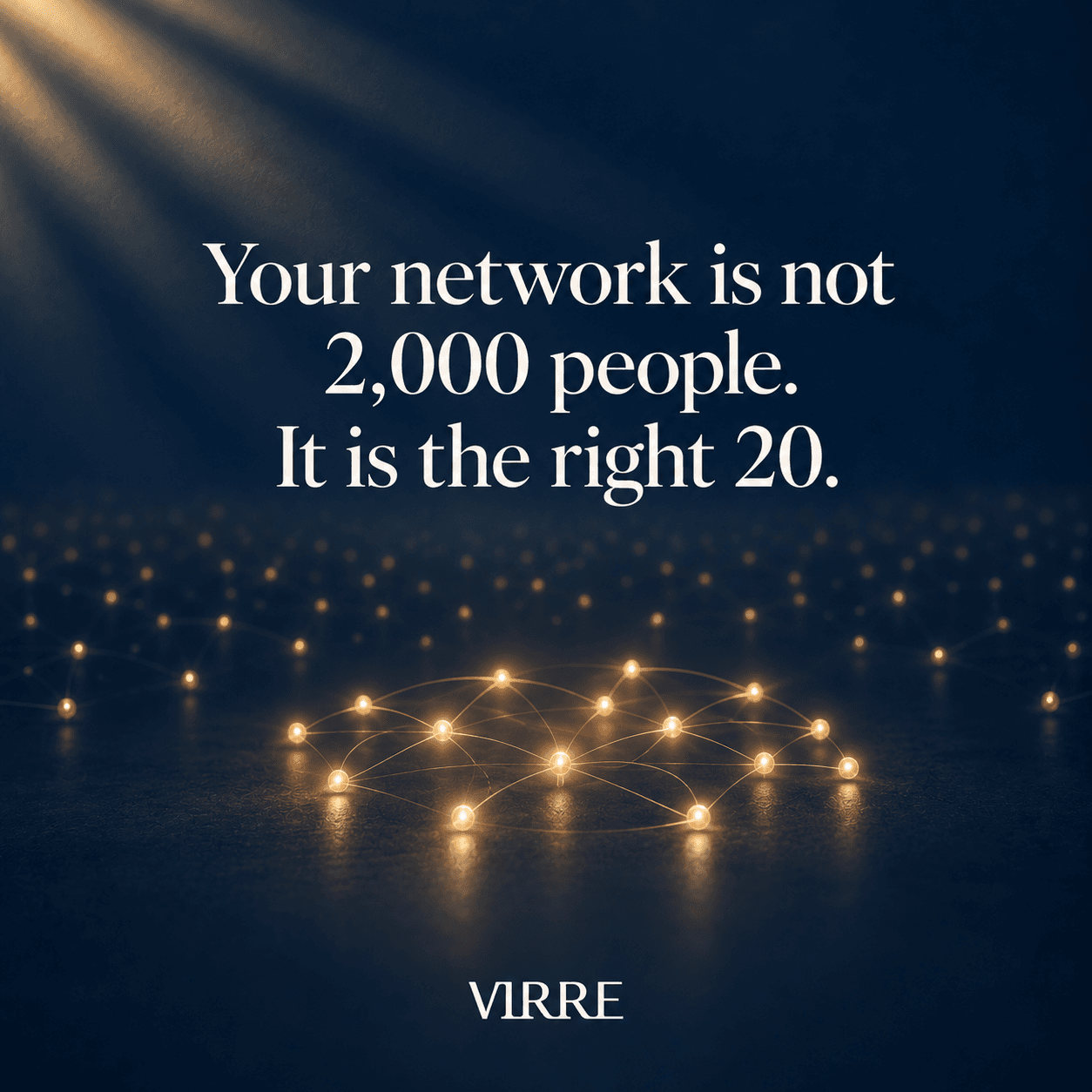
I have thousands of professional connections accumulated across more than twenty-five years of work, and for a long time I thought the problem was that I needed to become more disciplined about staying in touch with more of them.
I now think that idea was unrealistic from the beginning, because no serious professional has the time or emotional capacity to maintain thousands of relationships equally, and trying to do so usually produces one of two outcomes: either we do nothing because the task feels impossible, or we send generic messages at scale and call it relationship management.
The better question is not “How do I stay connected to everyone?”, because it is “Which twenty people deserve more attention for the chapter I am in right now?”
01Begin with your current goals#
The same network looks completely different depending on what you are trying to accomplish, because the twenty people who matter while searching for a new executive role may have almost no overlap with the twenty people who matter while fundraising, finding customers or pursuing board opportunities.
This sounds obvious, yet most contact systems start with the person and ask us to organize them afterward rather than starting with the goal and asking who becomes relevant because of it.
I would therefore write down no more than three important goals for the next six to twelve months before looking at my contact list.
02Then look for relevance#
For each goal, ask who has done something similar, who understands the market, who knows relevant people, who has seen your work, who could challenge your thinking and who may benefit from something you can offer.
This immediately produces a more useful group than sorting your network by title, because the former colleague who made the exact career transition you are considering may matter much more than a CEO who barely remembers meeting you.
03Add relationship strength#
Relevance without relationship strength can create false confidence, because knowing that someone is connected to a target company does not mean they know you well enough to make an introduction.
I would distinguish between people who know my work deeply, people with whom I have a meaningful but older relationship, people I know lightly and people who are essentially LinkedIn connections with very little relationship behind them.
That distinction determines what kind of outreach is appropriate.
04Add timing#
Someone can be highly relevant and still not require attention today, while another person may suddenly become important because they changed companies, attended the same event, launched something, raised funding or entered a market connected to your current goal.
This is why timing changes prioritization constantly.
The twenty people who matter most to your career are not fixed, because your goals change, their lives change and the meaning of the relationship changes with both.
05Do not confuse importance with seniority#
I made this mistake earlier in my career because senior people naturally appear important, although some of the most useful relationships in any network belong to peers, former team members, recruiters, connectors, customers and people whose careers later move in directions nobody could have predicted.
A network becomes much more powerful when we stop looking only upward.
06Create a moving top twenty#
I would maintain a small group of relationships connected to the things I care about now, while allowing that group to change as my goals change.
Some people will stay important for years because the relationship itself is deep, while others may become temporarily relevant to a project, transition or opportunity.
Virre’s Goal Mapping, Match Score, Analysis, Timeline and My Actions are designed to make that prioritization more visible, because the idea is not to tell people who they should care about but to help reveal which relationships connect most closely to what they are already trying to accomplish.
A large network becomes useful only when you can reduce thousands of names into a few relationships worth acting on today.
The goal is therefore not to manage two thousand people more efficiently.
The goal is to stop letting the two thousand hide the twenty.
Start with Virre and discover who matters, why they matter, and when to reach out.