NotesInsights8 mins read1,286 words
The Portfolio Career Is No Longer a Fallback. It's a Strategy.
Why more mid-career and senior professionals are choosing multiple roles over one, and what it takes to manage the relationships that make it work
 Virre Team · July 5, 2026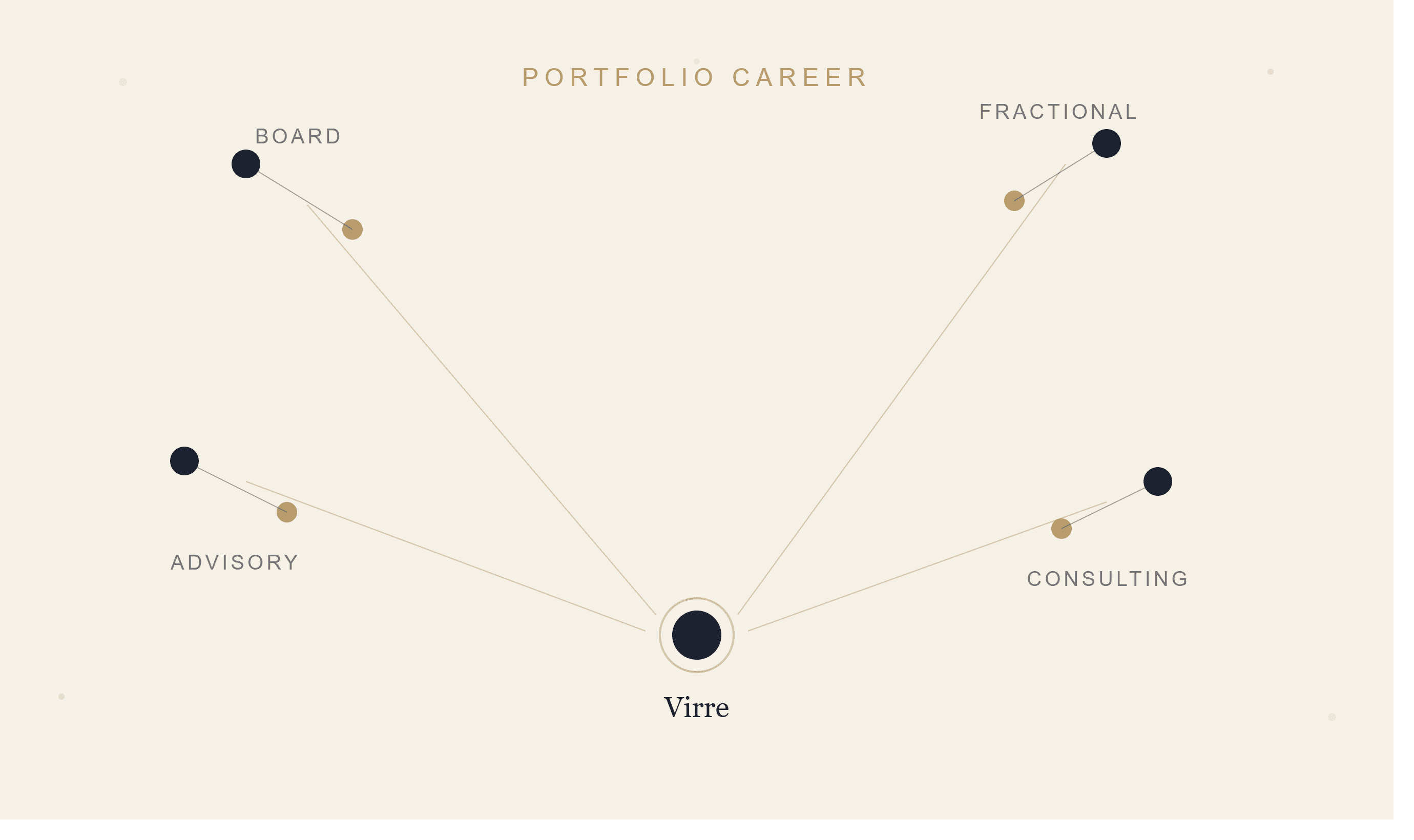
A portfolio career means building a professional life out of several concurrent roles, board seats, advisory work, fractional leadership, consulting projects, teaching or coaching, rather than one full-time job with one employer. It is not a stopgap between jobs and not a downgrade from a "real" career. For a fast-growing share of experienced professionals, it is now a deliberate, chosen structure, and one that comes with its own distinct set of demands, chief among them, managing far more professional relationships across far more contexts than a traditional single-employer career ever required.
01Why this is happening now#
Two forces are pushing this shift at the same time. On one side, AI-driven restructuring and a historically slow hiring market have made the traditional single-employer path feel less secure than it used to, pushing experienced professionals to diversify how they earn rather than depend on one employer's decisions. On the other side, companies themselves have discovered they can access senior-level expertise part-time, on retainer, or project by project, without the cost of a full-time executive hire, and they have responded by buying this kind of talent at scale.
The data on the second half of that shift is unambiguous:
- The global fractional executive market has passed $5.7 billion and is growing at roughly 14% a year, according to industry research compiled by Vendux. The number of professionals identifying as fractional executives has doubled in just two years, from around 60,000 in 2022 to roughly 120,000 by 2024. Source: Vendux, "10 Numbers That Will Reshape How You Think About Fractional Executives in 2026"
- 72% of CEOs say they plan to increase their use of fractional executives over the next 12 months, and demand for fractional hiring has surged 46% year over year, with finance, manufacturing, and healthcare now among the fastest-growing buyers, not just technology. Source: Metaintro, "Fractional Leadership in 2026: The Complete Guide"
This isn't a niche lifestyle choice anymore. It is company demand and professional supply moving toward each other at the same time, from both directions.
02The persona shift: who is actually adopting this#
The clearest adoption pattern right now runs through two overlapping groups.
Senior executives, particularly in finance, healthcare, and operations-heavy industries, are the most visible adopters. These are professionals with 15 to 25+ years of pattern recognition in a specific function, the kind of judgment that's genuinely difficult for a growing company to justify hiring full-time, but extremely valuable to have two or three days a month. A senior healthcare operations executive who has navigated multiple regulatory transitions, compliance overhauls, or hospital system integrations is exactly the kind of profile that a mid-size healthcare group or health-tech startup wants on retainer, not necessarily on payroll.
Mid-level IT and technology professionals with 8 to 15 years of experience are the newer, faster-growing wave. Someone who has led cloud migrations, built out a security practice, or scaled a data platform at one company increasingly finds that three or four smaller companies each want a slice of that exact expertise, rather than one company wanting all of it full-time. Technology is now the fastest-growing functional category in the fractional market by growth rate, even though finance and marketing still lead by raw volume.
What both groups have in common is a genuine, specific expertise that's valuable in short, high-leverage bursts, exactly the kind of value that doesn't require, or even benefit from, being locked into a single employer.
03The part almost nobody plans for: relationship overload#
Here is the piece of the portfolio-career shift that gets far less attention than the financial or lifestyle upside, and it's the piece that determines whether the model actually works long-term.
A traditional executive manages one organization's worth of relationships, one CEO, one board, one leadership team, one set of internal stakeholders. A portfolio professional is managing three, four, or five of these simultaneously, each with its own board members, its own internal politics, its own history, and none of them sharing a system with any of the others. There is no shared CRM across a board seat, a fractional COO engagement, and a coaching client. Everything lives in the portfolio professional's own memory, scattered notes, and inboxes, and it has to be recalled correctly and quickly, often within minutes of a meeting starting.
This is precisely why executive transition research consistently finds that network activation, not resume polish or job-board searching, is the highest-impact activity for anyone building or sustaining this kind of career. A portfolio career isn't sustained by a single strong relationship. It's sustained by dozens of moderately warm ones, board contacts, former colleagues who become referral sources, peers who recommend you into their own networks, all of which need to be remembered accurately across completely different contexts.
Marie Holive, COO of Proteus International and a three-time board member across public and private companies, described building her own portfolio career this way in a Forbes Business Council piece: she left a CEO role at a major media company at 40 to design something more deliberate, and over time added board roles, fractional COO work, and academic coaching at London Business School, one pillar at a time, tested and expanded gradually rather than launched all at once. Her account is a useful, honest one specifically because she's candid that it took years, dozens of rejected board applications, and a lot of deliberate relationship-building before the different pieces came together into something coherent. Source: Forbes Business Council, "Building A Portfolio Career: How To Redesign Your Work Life With Purpose And Agility"
That's the pattern worth noticing: successful portfolio careers are rarely built through more networking activity. They're built through better-maintained relationships across a small number of trusted circles, each one requiring its own context to be remembered correctly.
04Why a portfolio career needs one system, not five#
This is the exact problem Virre was built to solve, just applied to a professional managing several parallel relationship graphs instead of one. A portfolio professional doesn't need a bigger contact list. They need a private, reliable way to hold context across every engagement they're part of, who's on which board, what was last discussed with which client, which introduction came from which relationship, without any of it bleeding together or getting lost between contexts.
Rather than juggling separate mental models for each board seat, advisory relationship, or fractional engagement, Virre gives a portfolio professional one private system underneath all of them, so walking into any given meeting means arriving with the right context already in hand, not scrambling to reconstruct it from memory or old email threads.
05FAQs
A portfolio career is a professional structure built from multiple concurrent roles, such as board seats, fractional executive positions, advisory work, and consulting, rather than one full-time job with a single employer.
Two forces are converging: professionals seeking more security and autonomy after a wave of AI-driven layoffs and slow hiring, and companies increasingly choosing to access senior expertise part-time or on retainer rather than through full-time hires. The fractional executive market alone has passed $5.7 billion and continues to grow at roughly 14% annually.
Senior executives in finance, healthcare, and operations-heavy industries, along with mid-level technology professionals with 8 to 15 years of specialized experience, particularly in cloud, security, and data roles.
Relationship overload. A portfolio professional manages several separate organizations' worth of relationships simultaneously, board members, clients, referral sources, without any shared system between them, which makes remembering the right context at the right moment the hardest part of the model.
By providing a single private relationship system that holds context across every board, client, and advisory relationship a portfolio professional is managing, so no single engagement's history gets lost or confused with another's.