NotesCommunity Operations2 mins read420 words
How Many Tools Does It Take to Run One Community?
 Virre Team · September 14, 2026
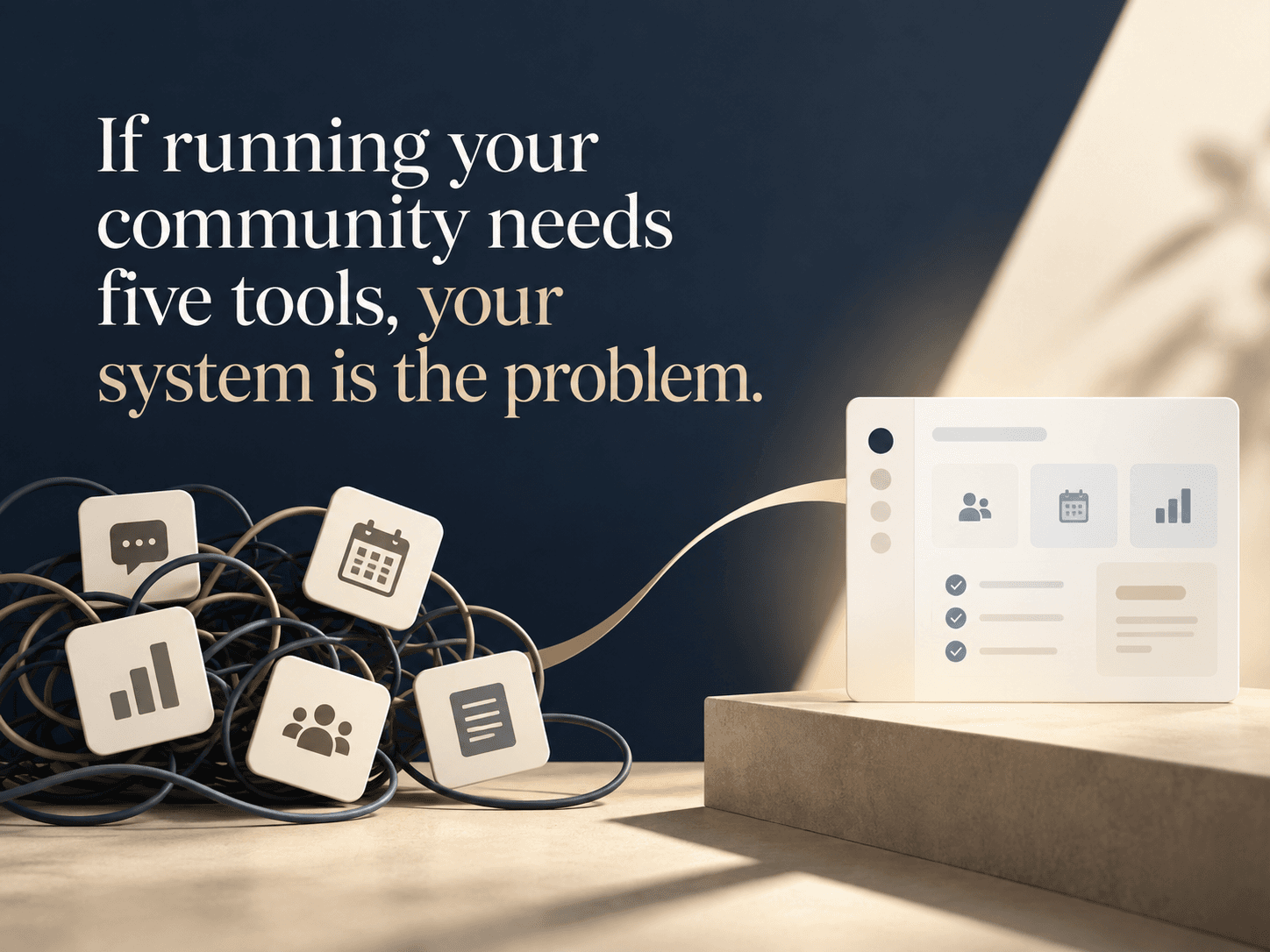
A community manager starts the morning in Gmail, checks a Slack channel, updates a Notion database, opens an event platform, copies attendance into a spreadsheet and then tries to remember whether the member who requested an introduction was tagged in Airtable or HubSpot.
Every tool may be good at its job. The problem is the work between the tools.
01Community managers are becoming integration managers#
Slack is excellent for fast conversation. Notion is excellent for flexible documents and databases. Event platforms are built for registration. Email platforms are built for campaigns. Spreadsheets are still unbeatable for quick ad hoc work.
The problem appears when a member moves through all of them. Their profile lives in one place, attendance in another, request in email, conversation in chat and introduction history in the manager's head.
That fragmentation creates hidden labor.
02What the market already offers#
Circle positions itself as an all-in-one community platform with events, chat, courses, email marketing, workflows, CRM-like member management and analytics. Mighty Networks combines community, events, chat, courses, member discovery and automations. Glue Up connects membership management, CRM, email, events, directories and community engagement.
This means “all-in-one” is no longer enough as a positioning claim. Community managers should ask a harder question: What becomes easier because the data is connected?
03Virre's center of gravity is the relationship#
Virre is not trying to win by reproducing every possible feature from every community product. The stronger idea is that email, events, member profiles, conversations, introductions and goals should contribute to one relationship context.
When a member attends an event, that should matter to future recommendations. When they ask for help, that should affect the member record. When an introduction happens, it should become part of the history. When a manager sends an email, it should not begin from zero.
04Consolidation should create intelligence#
Replacing five tools with one is nice. Replacing five disconnected sources of context with one system that understands what is happening is much more valuable.
That is the standard community managers should use when evaluating software: not “How many features are on the pricing page?” but “How much manual stitching disappears from my week?”
05FAQ
Common stacks include chat tools such as Slack or Discord, databases such as Notion or Airtable, email platforms, event tools, CRMs, analytics products and spreadsheets.
At minimum, member profiles, communication, events, engagement tools, analytics, automation and integrations. For relationship-led communities, introductions and context are increasingly important as well.
Not necessarily. The decision should depend on where fragmentation creates work. A good platform can also integrate with tools a team wants to keep.
Explore Virre for Communities: https://www.virre.ai/solutions/communities